
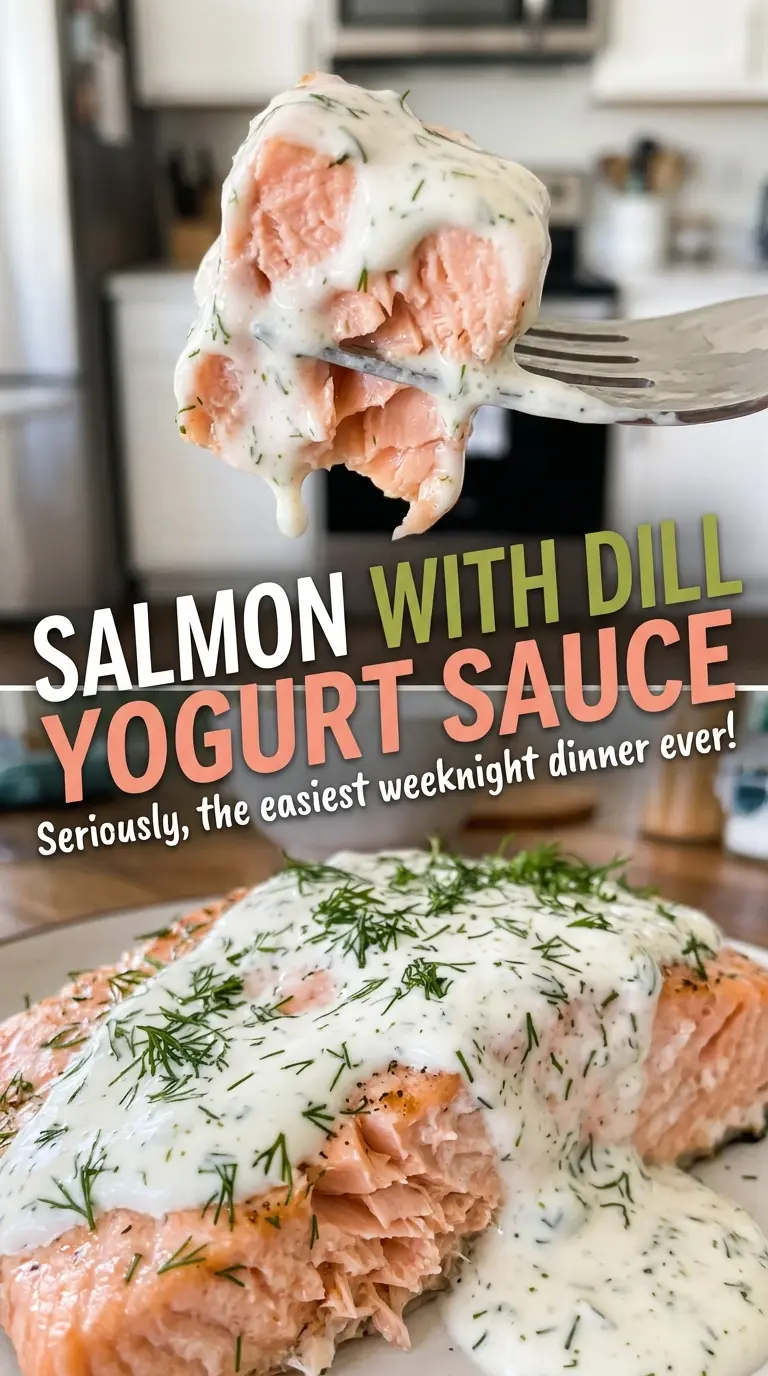
The best moment is when a fork slides into the thickest part of a salmon fillet and the flesh separates into moist flakes. A simple bake keeps dinner straightforward, while a cool dill yogurt sauce brings lemony tang to every bite. I make Salmon with Dill Yogurt Sauce when I want the salmon to stay the focus and still have something bright and creamy on the plate.
The sauce comes together in a bowl while the fish bakes, so there’s no second pan to manage. Fresh dill gives the yogurt a clean, grassy flavor, and finely grated garlic spreads through it instead of leaving a sharp chunk in one bite. Served alongside the warm salmon, the sauce adds contrast without covering up the fish.

Kitchen Note
Finely grate the garlic so it disappears into the yogurt instead of leaving a strong bite in one spot. A microplane makes quick work of a small clove.
Save Salmon with Dill Yogurt Sauce for a simple dinner with tender baked fish and a bright, creamy dill topping.
Why the Yogurt Sauce Goes Beside the Salmon, Not Into the Oven
Greek yogurt makes a quick, tangy sauce, but it’s at its best when it stays out of the oven. Heat can make yogurt sauces lose their smooth texture, and baking the sauce on the fish would also soften the fresh, lemony contrast that makes this pairing work. Keeping the two separate gives you tender salmon and a sauce that still tastes bright.
Serve the sauce alongside the fillets, or spoon a little over each portion just before eating. That lets you control how much reaches the fish, and any sauce left in the bowl stays available for another bite. The salmon is seasoned simply with olive oil, kosher salt, and black pepper, so the dill and lemon add definition rather than competing with a heavy coating.
What Fresh Dill and Thick Greek Yogurt Contribute to This Sauce
- Skin-on salmon fillets — The skin helps the fillets hold together as you move them, and it creates a natural barrier between the fish and the parchment. Choose fillets of similar thickness when you can so they finish baking at about the same time.
- Plain Greek yogurt — Its thickness gives the sauce body, so it clings to the fish instead of running across the plate. A full-fat yogurt makes a richer sauce; a lower-fat plain Greek yogurt works too, though it tastes less creamy. Avoid flavored or sweetened yogurt here.
- Fresh dill — Freshly chopped dill brings the crisp, green flavor that defines the sauce. If fresh dill isn’t available, dried dill works in a smaller quantity; the flavor will be more concentrated and less delicate.
- Lemon juice and garlic — Lemon cuts through the richness of the fish and yogurt, while garlic gives the sauce a savory edge. Fresh lemon juice tastes livelier than bottled, but bottled juice is fine when that’s what you have.
- Olive oil, kosher salt, and black pepper — Olive oil helps the seasoning coat the salmon evenly. Use the kosher salt and black pepper as listed; the yogurt sauce has its own salt, so the fish and sauce each get seasoned separately.
Bake the Salmon First, Then Stir Together the Sauce
Set up a parchment-lined baking sheet
Heat the oven to 400°F and line a rimmed baking sheet with parchment paper. The rim keeps any juices on the pan, while the parchment helps the skin-on fillets release cleanly. Arrange the salmon skin-side down with a little space between the pieces. If the fillets are crowded, they’re harder to handle and the edges won’t bake as evenly.
Oil and season the fish evenly
Brush the salmon with the olive oil, then season the tops evenly with the 1/2 teaspoon kosher salt and 1/4 teaspoon black pepper. Spread the oil over the surface rather than leaving one slick patch. Keep the fillets skin-side down so the flesh is facing up for seasoning and checking. An even coat means each bite gets the same simple seasoning.
Use the thickest part to judge doneness
Bake the salmon for 12 to 15 minutes. Thickness matters more than the clock, so check the center of each fillet rather than judging only by the edges. Insert an instant-read thermometer into the thickest part of each piece; it should register 145°F. Don’t check only one fillet if the pieces vary in thickness.
Stir the dill yogurt sauce in a small bowl
Stir together the plain Greek yogurt, chopped fresh dill, lemon juice, finely grated garlic, and 1/4 teaspoon kosher salt. Mix until the dill and seasoning are distributed throughout, with no concentrated pockets of garlic or salt. Set the bowl out with the baked salmon and serve the sauce alongside. Keeping it separate preserves its creamy texture.
Three Useful Ways to Adapt the Salmon and Dill Yogurt Sauce
Use parsley when dill isn’t your favorite
Swap the chopped fresh dill for chopped flat-leaf parsley. The sauce will taste milder and less grassy, while the yogurt and lemon still give it a fresh, tangy lift.
Make the sauce dairy-free
Replace the Greek yogurt with a thick, plain, unsweetened dairy-free Greek-style yogurt. The sauce may be a little less rich, so choose a variety with a firm texture rather than a pourable one.
Leave out the garlic for a gentler sauce
Omit the garlic if you want the dill and lemon to come through without its savory bite. The sauce will taste cleaner and milder, but it will still pair well with the simply seasoned salmon.
Storage and Reheating
- Refrigerator: Store salmon and sauce in separate airtight containers, refrigerate within 2 hours, and use within 3 to 4 days. The sauce may loosen a little as it sits.
- Freezer: Freeze the cooked salmon without the yogurt sauce for up to 2 to 3 months for best quality. Greek yogurt sauce can separate after freezing, so it’s better made fresh.
- Reheating: Warm the salmon gently in the microwave at medium power in short bursts. High heat dries out the fish quickly; keep the sauce cold and serve it on the side.
Questions That Come Up While Baking Salmon with Dill Yogurt Sauce
Salmon with Dill Yogurt Sauce
Ingredients
Equipment
Method
- Heat the oven to 400°F and line a rimmed baking sheet with parchment paper.
- Arrange the salmon skin-side down on the baking sheet, brush with the olive oil, and season evenly with the 1/2 teaspoon salt and black pepper.
- Bake for 12 to 15 minutes, until the thickest part of each fillet registers 145°F on an instant-read thermometer.
- Stir together the Greek yogurt, dill, lemon juice, garlic, and 1/4 teaspoon salt in a small bowl.
- Serve the sauce with the salmon.