
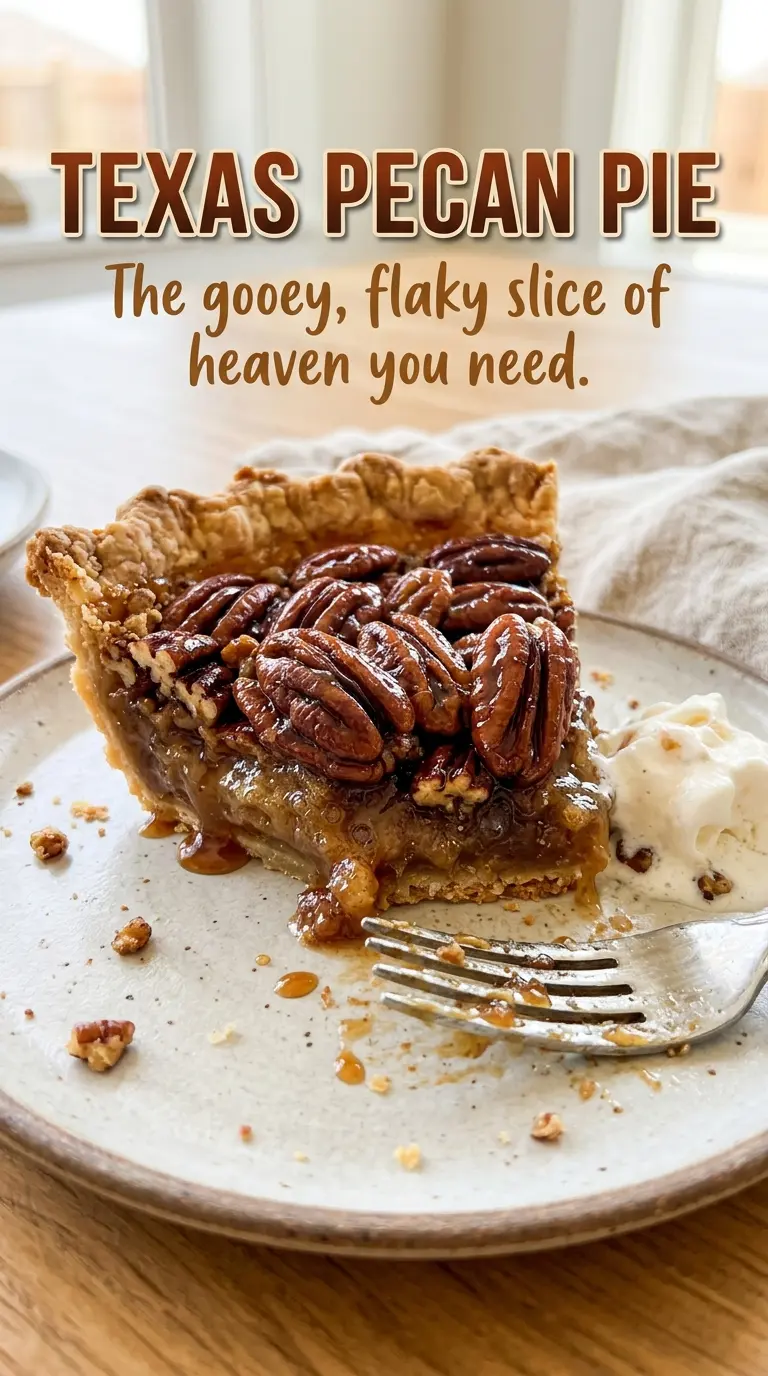
The filling in a pecan pie can look almost set around the edge while the middle still moves when you nudge the pan. That slight wobble used to make me reach for the oven door too soon, but it’s the cue I watch for now. This Texas pecan pie bakes in a 9-inch crust with a smooth brown sugar filling and pecan halves stirred right in.
I keep the crust chilled while I mix the filling, which gives me time to whisk everything smooth without letting the pastry sit out on the counter. The filling comes together in one bowl, and the pecans go in last so they stay whole. Once baked, the pie needs a long, undisturbed cool before slicing; the wait is what turns the soft center into neat, sliceable filling.

Kitchen Note
I set the filled pie plate on a rimmed baking sheet before it goes into the oven. It’s much easier to move a full pie that way, and the sheet catches any filling that might bubble over.
Save this Texas pecan pie for its tender brown sugar filling and whole pecans tucked into every slice.
Why the Center Should Still Wobble When the Pie Leaves the Oven
A pecan pie doesn’t need to look firm all the way across when you take it out. The edges should be set, but the center should still have a slight wobble. Waiting for the middle to become completely still in the oven risks baking it past that soft, cohesive texture this pie is meant to have.
That movement can be hard to judge if you’re expecting the filling to behave like a cake. Give the pie plate a gentle nudge rather than shaking it. The outside should hold its shape while the center moves slightly as one area, not slosh like liquid. If the whole surface ripples freely, it needs more oven time; if the center is completely rigid, it has gone further than the target cue.
Use the range of bake time as a guide, not a reason to ignore what you see. Ovens vary, and the crust edge can brown faster than the filling sets. The loose foil cover is there for the crust edge if it’s coloring too quickly, while the pie continues baking toward that set-edge, gently-wobbly-center finish.
What the Syrup, Sugar, and Pecans Each Bring to This Filling
- Light corn syrup — It gives the filling its smooth, cohesive texture and keeps the brown sugar from being the only source of sweetness. I stick with light corn syrup for this version; another syrup would change the taste and may set differently.
- Light brown sugar — Packed light brown sugar adds a mellow molasses note alongside the syrup. Fresh, soft brown sugar blends most easily; if yours has hardened into lumps, break them up before whisking so they don’t linger in the filling.
- Eggs — The eggs help the filling set as the pie bakes and cools. Use large eggs, as listed, so the filling has the right balance of structure and softness.
- Pecan halves — Whole halves give the pie its recognizable nutty bites and keep the filling from becoming uniformly fine-textured. Choose pecans that smell fresh and sweet rather than stale or bitter; the nuts are a prominent part of every slice.
- Unsalted butter and vanilla — Melted, cooled butter blends into the filling without cooking the eggs on contact, while vanilla rounds out the brown sugar. Let the butter cool before whisking it in.
- Refrigerated pie crust — An unbaked 9-inch crust keeps this a straightforward pie to assemble. Fit it into the plate and crimp the edge before you make the filling, then keep it chilled as you work.
From Chilled Crust to a Clean Slice: The Stages That Matter
Fit the Crust and Keep It Cold
Heat the oven to 350°F with a rack in the lower third. Fit the unbaked crust into a 9-inch pie plate and crimp the edge, then leave the plate chilled while you make the filling. A tidy crimp gives the crust a finished edge, but don’t stretch the pastry tight across the plate; it should sit naturally in place. Starting with the crust ready means the filling can go straight in once it’s mixed.
Whisk Until the Filling Looks Smooth
In a medium bowl, whisk the eggs, corn syrup, brown sugar, melted and cooled butter, vanilla, and salt until smooth. Keep whisking until you don’t see streaks of egg white or pockets of brown sugar. The cooled butter should blend in rather than separate on the surface. Stir in the pecan halves after the mixture is smooth so they’re distributed through the filling.
Fill the Pie and Watch the Crust Edge
Set the pie plate on a rimmed baking sheet and pour in the filling. Bake on the lower-third rack for 55–65 minutes, checking the crust edge as the pie bakes. If that edge is browning too quickly after 25 minutes, loosely cover it with foil; keep the foil from pressing down on the filling. The pie is ready when the edges are set and the center still has a slight wobble.
Let the Filling Finish Setting
Move the pie to a rack and leave it undisturbed for at least 3 hours before slicing. The filling continues to firm as it cools, so cutting early can leave you with a loose center even when the bake itself was on track. For cleaner slices, use a sharp knife and wipe it between cuts. Letting the pie rest fully is part of the method, not an optional pause.
Small Changes That Keep This Texas Pecan Pie on Track
For smaller pecan bites
Chopped pecans can stand in for the halves without changing the rest of the filling. Keep the same amount of pecans, and expect a more even distribution of smaller nut pieces rather than distinct halves in each slice.
For a gluten-free table
The crust is the part that needs adapting. Use a refrigerated gluten-free pie crust made for a 9-inch pie plate, and keep the filling the same; check the crust’s package for any handling differences so it fits the plate without tearing.
Storage and Reheating
- Refrigerator: Cover cooled leftovers and refrigerate for 3–4 days. The filling firms when cold, so slices will be less soft straight from the fridge.
- Freezer: Pecan pie freezes well. Wrap individual slices or the cooled pie tightly, freeze for up to 2 months, and thaw in the refrigerator.
- Reheating: This pie is good chilled or at room temperature and doesn’t need reheating. If you prefer a less-cold slice, let it sit out briefly rather than microwaving it, which can soften the crust unevenly.
Questions That Come Up When Baking Pecan Pie
Texas Pecan Pie
Ingredients
Equipment
Method
- Heat the oven to 350°F with a rack in the lower third.
- Fit the pie crust into a 9-inch pie plate and crimp the edge; keep it chilled while you make the filling.
- In a medium bowl, whisk the eggs, corn syrup, brown sugar, melted butter, vanilla, and salt until smooth.
- Stir in the pecan halves.
- Set the pie plate on a rimmed baking sheet.
- Pour in the filling.
- Bake for 55–65 minutes, loosely covering the crust edge with foil after 25 minutes if it is browning too quickly, until the edges are set and the center still has a slight wobble.
- Cool the pie on a rack for at least 3 hours before slicing so the filling can set.