
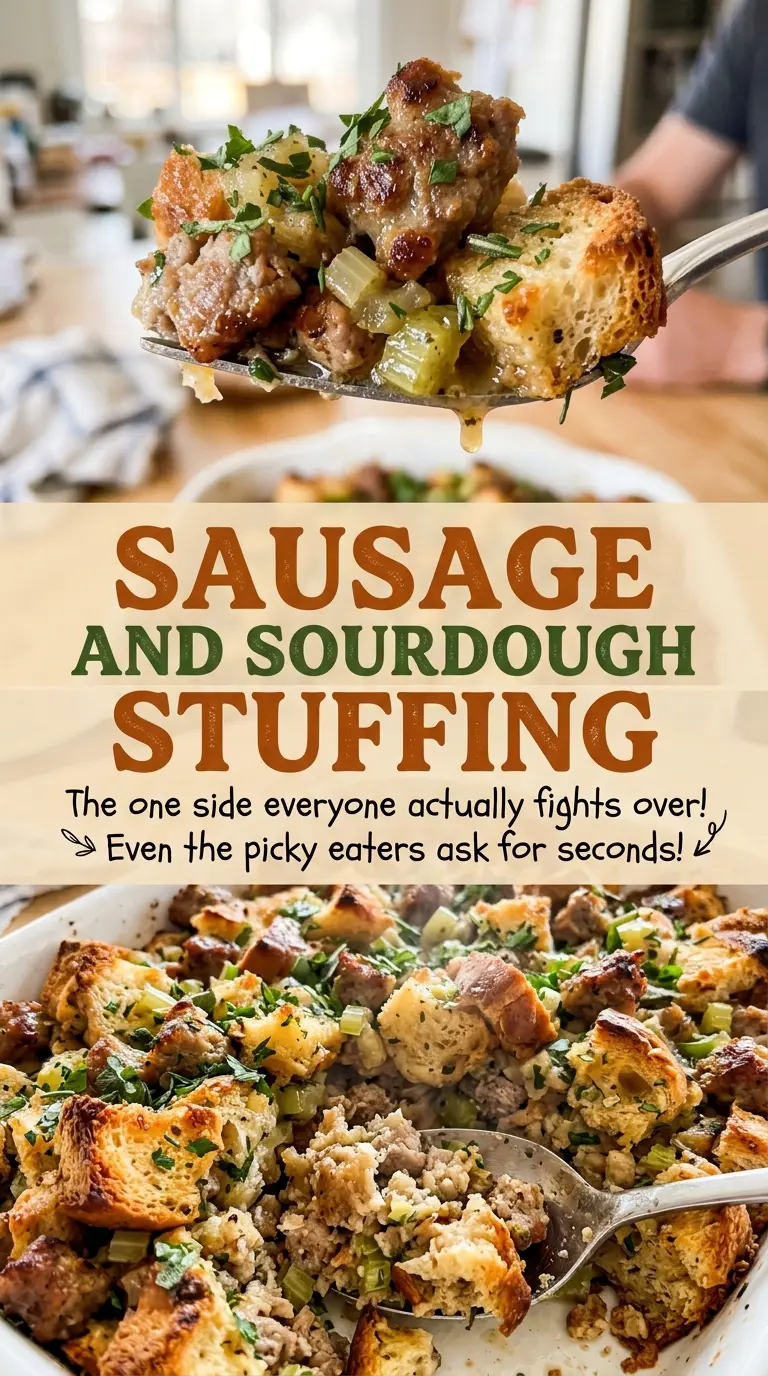
The bread cubes are the first thing I pay attention to when I make stuffing. If they’re still soft in the middle, they can turn the whole pan heavy once the broth goes in. For this sausage and sourdough stuffing, I dry the cubes in a low oven first, then let the sausage and softened vegetables bring the savory part to the bowl.
Sourdough gives the stuffing a little tang, while pork sausage makes it hearty enough to serve as more than a side. I whisk the broth and eggs together before pouring them over the bread, which makes it easier to moisten the cubes evenly. After baking covered, the top gets time uncovered to turn golden, and a short rest helps the center settle into generous, scoopable portions.

Kitchen Note
Give the baked stuffing its full 10-minute rest before serving. It’s still hot, but those minutes let the center settle so you can scoop it without the pieces immediately falling apart.
Save this sausage and sourdough stuffing for its tangy bread, savory pork sausage, and golden top.
Why the Broth and Eggs Go in After the Bread and Sausage
It’s easier to control the texture when the bread, sausage, and vegetables are already combined before the liquid goes in. The broth and eggs need to reach the bread throughout the bowl, not collect in one damp patch at the bottom of the baking dish. Whisking them together first spreads the egg through the broth, and tossing that mixture with the bread gives each cube a chance to take up some moisture.
The eggs help hold the baked stuffing together, while the broth softens the bread. If you pour in the liquid before the sausage and vegetables are distributed, some cubes can get soaked while others stay dry. Toss gently but thoroughly, scraping up from the bottom of the bowl as you go. Stop when the bread looks evenly moistened; crushing the cubes at this point makes the finished texture denser. That balance is what gives you a tender middle with distinct pieces of sourdough instead of a uniform, soft mass.
How Sourdough, Sausage, and Herbs Shape Each Bite
- Sourdough bread — Its tang keeps the stuffing from tasting one-note beside the rich pork sausage. A firm, crusty sourdough loaf is easiest to cube neatly. If you need to substitute, a sturdy country-style loaf works, though you’ll lose some of that sourdough tang; cut it into the same size cubes and dry it as described below.
- Bulk pork sausage — This brings both browned meat and seasoning to the pan. Choose bulk sausage rather than links so it’s easy to break into small pieces as it cooks. The sausage’s seasoning varies by brand, so taste the cooked mixture before adding anything beyond the listed seasonings.
- Yellow onion, celery, and garlic — Finely chopping the onion and celery helps them soften in the skillet and distribute through the bread instead of leaving large, crunchy bites. Mince the garlic so it blends into the butter and herbs without a sharp, concentrated piece.
- Butter and chicken broth — The butter carries the softened vegetables and dried herbs, while low-sodium broth moistens the bread without making the finished dish overly salty. The butter is divided between greasing the baking dish and cooking the vegetables, so keep both portions in mind as you prep.
- Sage, thyme, parsley, and eggs — Dried sage and thyme season the warm butter mixture; fresh parsley adds a brighter note when it’s tossed in with the bread. The eggs are whisked into the broth to help bind the stuffing, so don’t add them directly to the hot skillet.
Drying the Bread Before Building the Stuffing
Dry the cubes until crisp
Heat the oven to 300°F and spread the 1-inch sourdough cubes in a single layer on a rimmed baking sheet. Bake for 25 to 35 minutes, stirring once, until the cubes are dry and crisp. If the cubes are crowded, they won’t dry as evenly, so give them room on the sheet. Transfer them to a large bowl when they’re ready.
Brown the sausage and prep the dish
Increase the oven temperature to 350°F and grease a 9×13-inch baking dish with 1 teaspoon of butter. In a large skillet over medium-high heat, cook the bulk pork sausage for 8 to 10 minutes, breaking it into small pieces as it browns. It’s ready when browned and at 160°F. Transfer it to the bowl with the bread rather than leaving it in the skillet.
Soften the vegetables in the sausage skillet
Melt the remaining butter in the same skillet, then add the finely chopped onion and celery. Cook for 6 to 8 minutes, stirring occasionally, until they’ve softened. Stir in the minced garlic, sage, thyme, salt, and pepper, and cook for 1 minute. Keep stirring during that final minute so the garlic and dried herbs warm in the butter without sticking.
Moisten, cover, and bake
Add the skillet mixture and chopped parsley to the bread and sausage, then toss to combine. Whisk the broth and eggs in a medium bowl, pour them over the bread mixture, and toss until evenly moistened. Transfer everything to the prepared dish, cover tightly with foil, and bake for 30 minutes; uncover and bake for 15 to 20 minutes more, until the top is golden and the center reaches 165°F.
Let the center settle
Take the dish out of the oven and let the stuffing rest for 10 minutes before serving. The center is softer than the top when it first comes out, so give it that time rather than stirring or scooping immediately. Then serve it straight from the baking dish.
Two Easy Ways to Adapt the Sourdough Stuffing
Make it gluten-free
Replace the sourdough with an equal volume of gluten-free sourdough bread and cut it into 1-inch cubes. Dry the cubes until crisp before mixing them with the other ingredients. Gluten-free bread can bake up a little more compact, but it still makes a savory, sliceable stuffing.
Turn up the sausage’s heat
Choose hot bulk pork sausage instead of a mild version for a pepperier, more assertive stuffing. Keep the rest of the ingredients the same; the sausage seasoning will do the work, so don’t add extra salt without tasting the cooked mixture first.
Storage and Reheating
- Refrigerator: Refrigerate leftovers in a covered container for 3 to 4 days. The crisp top softens as it sits.
- Freezer: Freeze cooled portions in airtight containers for up to 1 month for the best texture. Thaw overnight in the refrigerator before reheating.
- Reheating: Warm covered portions in the oven or microwave until steaming hot throughout. Uncover the oven dish near the end if you’d like to bring back some crispness; repeated reheating dries out the bread.
Questions That Come Up When Making Sausage Stuffing
Sausage and Sourdough Stuffing
Ingredients
Equipment
Method
- Heat the oven to 300°F.
- Spread the sourdough bread cubes in a single layer on a rimmed baking sheet.
- Bake for 25 to 35 minutes, stirring once, until dry and crisp, then transfer the bread cubes to a large bowl.
- Increase the oven to 350°F and grease a 9x13-inch baking dish with 1 teaspoon of the butter.
- Cook the pork sausage in a large skillet over medium-high heat for 8 to 10 minutes, breaking it into small pieces, until browned and it reaches 160°F, then transfer it to the bowl with the bread.
- Melt the remaining butter in the skillet.
- Add the onion and celery and cook for 6 to 8 minutes, stirring occasionally, until softened.
- Stir in the garlic, sage, thyme, salt, and pepper and cook for 1 minute.
- Add the skillet mixture and parsley to the bread and sausage, and toss to combine.
- Whisk the broth and eggs together in a medium bowl, pour over the bread mixture, and toss until evenly moistened.
- Transfer the mixture to the prepared baking dish and cover tightly with foil.
- Bake for 30 minutes, then uncover and bake for 15 to 20 minutes, until the top is golden and the center reaches 165°F.
- Let the stuffing rest for 10 minutes before serving.